The content was clearly very moving. And his delivery was both clear and powerful.
But what really made us sit up and listen was the shock of seeing someone who always cracks jokes suddenly and unexpectedly speaks with full sincerity.
From the Green Room: The next time you speak, take a moment to drop your usual persona and try something radically different. If you're normally loud - get quiet. If you are very serious - act goofy. And if you are always the comedian, take a moment to speak personally and sincerely to your listeners.
Your audience will remember that moment not only because it's so unexpected, but because you had the courage to reveal another side of yourself.
The Folsom Prison scene from Walk the Line is so fantastic, I had to use it again.
The prison warden cautions Johnny Cash (Joaquin Pheonix) not to sing a song that reminds the prisoners they are in prison. Cash looks up and says, "You think they forgot?" He then walks out on stage, thanks the men for being "the best audience we've ever had" and sings Cocaine Blues:
When I was arrested I was dressed in black They put me on a train and they took me back Had no friend for to go my bail they slapped my dried up carcass in that country jail
How do the men react? They love it.
The scene has a decidedly redemptive quality to it. Out of respect for their current state, Cash chooses to sing a song about a criminal going to jail. And this is actually what enables the audience to transcend their current state and sing and cheer joyfully along with him.
From the Green Room: Whether you have bad news to give or you're speaking to an audience who's going through a rough time, don't hide from it. Go there with your audience. This kind of sincere honesty is both respectful and redemptive.
Using a prop, if it's done well, can be a powerful tool to make your message stick.
For a great example of this, watch the Folsom prison scene from the movie, Walk the Line:
From the Green Room: Try using a prop - and one prop only - to visualize and concretize your message. If you do it right, it could be the most memorable and powerful moment of your presentation.
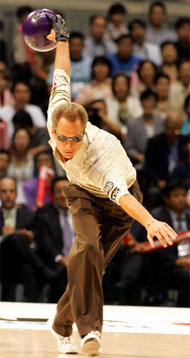
Most of the time, bowlers first learn how to master the straight throw before they learn the hook.
As a beginning speaker, it can be tempting to experiment by throwing the audience a curve ball - taking them in a direction they don't expect at the start.
While I am all for creativity and risk taking, I follow the wisdom of the bowler.
Before you try to master the curve approach, first get your "straight throw" presentation down cold. No fancy footwork or great surprises. Just meaningful content and a powerful delivery.
Once you have that down, you can begin to learn how to throw a hook.
During the third frame, I threw the bowl straight down the middle - like an arrow pointed towards the center of the dart board.
To my dismay, I only knocked down seven pins. To make matters worse, the three pins left were on opposite sides of the alley. What's a bowler to do?
Turns out, the middle pin or head pin is not the one you want to hit if you hope to knock 'em all down.
A few frames later, I hit the pocket, that space right between the head pin and either pin next to it. Strike!
Often when we get up to speak, we try to hit that middle pin. We make our point so clearly and so directly, that we leave no space for the audience to absorb it. When you deliver the "straight down the middle" speech, many people may your understand message, but you will never truly wow the audience - you will never bowl a strike.
A really great speaker has the ability to deliver a message with force and precision - while deliberately leaving space for the audience to have that moment of self-discovery and transformation.
From the Green Room: When you get up to speak, aim for the pocket. Aim not just to get your point across, but to communicate in such a way to enables your listeners to discover your message for themselves.
Someone who read my last post on the Karate Kid asked me, "How can I ever hope to prepare like Danny LaRusso? I don't have time to practice repetitive motions all day!"
Oh yes, you do.
The average person speaks 16,000 words per day. That's 16,000 chances to practice your speaking skills.
The next time you are talking with a friend, practice maintaining sustained eye contact. The next time you read a story to your child, practice varying your voice. And the next time you speak to a sales clerk at the grocery store, practice keeping your body in an open stance.
Mr. Miyagi would be proud.
From the Green Room: Each day provides us with dozens of opportunities to practice using our voices. The more you work at strengthening your voice in casual conversation, the better you will sound when you get up to give a speech.
Yesterday, our family spent a delightful morning (re)watching the Karate Kid.
One of my favorite scenes in the movie was when Mr. Miyagi teaches Daniel LaRusso karate by having him do a series of seemingly endless chores. For each chore, he instructs to Daniel to use a specific arm motion over and over again.
Frustrated, Daniel wonders when he will ever learn "real Karate?"
Just as he is about to throw in the towel, Mr. Miyagi demonstrates that the very motions he used to sand the floor, wax the cars, and paint the fence were exactly the motions Daniel needed to effectively block any punch. Those hours and hours he had spent practicing and mastering those simple motions paid off in spades.
One of the lessons we can learn here is about the importance of preparation.
People often ask me, "How can I learn to speak on the spot?" There are no magic tricks to mastering this skill.
If you know your stuff, keep up on your reading, and walk into meetings assuming that you could be asked to speak, you will do just fine. From the Green Room: Being prepared means knowing your area of expertise well enough so that you are able to speak comfortably about it at any time. Each time you enter a situation where you could be asked to say something, assume you will be and prepare accordingly. Keep doing it. Over time, this will get easier and easier.
My five-year old son is passionately interested in space shuttles.
As a near complete ignoramus on the subject, I am grateful to be learning new things from him each day.
Just recently, for instance, he opened my eyes to the wonder of the Solid Rocket Boosters (SRBs). I had no idea, for example, that two SRBs provide the main thrust to lift the shuttle off the launch pad. Once the shuttle has reached an altitude of 150,000, the rockets drop into the ocean and are subsequently recovered.
Imagine that.
These enormous rockets' sole purpose is the get the shuttle on it's way.
Then it hit me.
This is what's missing from so many presentations.
So often, we begin a presentation with hesitation and self-deprecation, when what we really need is 2,800,000 pounds of force. Without a powerful lift-off, your presentation will never get off the ground.
What every presentation needs is a pair of Solid Rocket Boosters.
Let's call the first one the "Content Rocket Booster." Get right into the heart of your message. Don't waste time with pleasanteries. Demonstrate immediately that you have something significant to offer your listeners.
Let's call the second one the "Delivery Rocket Booster." This rocket takes off from the moment you walk up to the podium. Even your most powerful content will lose it's liftoff force if it is not supported by your delivery.
And the amazing thing about your SRBs? Like the space shuttle SRBs, you can reuse them again and again. Once you have developed one powerful opener, you can replicate much of the energy, structure, and delivery in subsequent presentations.
From the Green Room: Think of your opener as a space shuttle liftoff. You need extra power - in both content and delivery - to fully capture the audience's attention and get your speech off the ground.
As a small business owner, I looked forward to hearing this ABC video, "Winners of the Home-Based 100." Rich Sloan, co-founder of StartupNation discusses three of the winners and the entrepreneurial strategy each one uses. Click on the link below and then click on the second video at the bottom of the screen.
Thefirst company offers a cognitive lesson. Sloan talks about Priceless Profiles, a company that produces improved profiles for online dating. The take-home strategy here is that the company takes a common skill (writing) and uses it in an uncommon market. This is clearly a knowledge-based strategy.
Thesecond company immediately connects to our emotions. Haralee Weintraub, a breast cancer survivor, had suffered from night sweats during her chemo-therapy treatment and started a business selling wicking PJs. The listener could not help but feel inspired and moved by Haralee's story.
Finally, the third company tackled the action piece. Christine Perkett, founder of Perkett PR, advises entrepreneurs to "Listen as much as you can" to what the market is saying.
From the Green Room: When using the Rule of Three, the order matters.
1. Know. First give your listeners a vital piece of information. 2. Feel. Next, connect to their emotions. 3. Do. Finally, tell them exactly what action you want them to take.
Know. Feel. Do. It's simple, it's clear and it works.
Here's something we all know - but too often forget:
If your words say one thing and your delivery says the opposite, your audience almost always believes your delivery.
Watch the song "Stay Awake" from Mary Poppins, and let it serve as a gentle reminder of this principle:
From the Green Room: Synthesize your content and your delivery. If your words are meant to inspire and awaken, and your message doesn't match, you just might end up (in your case, unintentionally) putting your audience to sleep!
In his Thanksgiving proclamation, Lincoln spoke of the importance of gratitude in a time of profound national strife. But as eloquent as his words may have been, it was only his call to action that gave his statement such lasting impact:
Lincoln's moving proclamation is a powerful reminder of the importance of including a clear action step in almost any speech.
Only rarely do we give a fully informative speech. Almost always, there is something we want our listeners to do.
We celebrate Thanksgiving each year as a national holiday because one leader called us to action. Each presentation is an opportunity not simply to inform but to influence change.
From the Green Room: Each time you prepare a presentation, ask yourself:
What do I want my audience to do after hearing me?
Then decide on a specific action. Clarifying the goal beforehand will help guide and focus your presentation.
Yesterday I led a presentation skills training for a group of nonprofit fundraisers.
As we practiced "connection techniques" (ways to use voice, body language, and eyes to connect with the listener), one participant asked,
"Many times, we have to make phone calls to people we don't know. How can we apply this training?"
I had a difficult time answering him.
On one hand, I could help him find ways to connect with a stranger over the phone. (vocal variation, warmth of tone, etc.) But really, I knew this would be insufficient.
Phone solicitations work when the listener has already made a commitment. The phone call merely seals the deal. The goal here is not connection - but rather completion.
The power of conversation can only be truly realized in a live format.
While so much is lost in non-live exchange, perhaps the greatest sacrifice is eye contact.
As a speaker, the most powerful way to engage your listener is by truly looking him in the eye. This is true whether you are speaking to an audience of 1 or 1,000.
On a fundamental level, human beings want to be seen.
And making eye contact is the most fundamental and the most powerful to do this.
From the Green Room: If you really need something from somebody, don't sacrifice your greatest asset - your eyes. Take the time to meet face to face and make sustained, direct eye contact. Even if you are speaking to a large group, this is the most powerful way to connect.
Today I taught a music class for a group of 2-year olds.
One of the songs they like best is called "Me, You, We."
Each verse contains three lines of one word each:
Me
You
We
then...
Yes
No
Maybe
and finally...
I
Love
You
That's it. Really.
And the kids love it! Why? Because it's so easy to remember.
Today I realized that even at the tender age of two, people respond to the Rule of Three.
People remember things much more in threes than they do in twos - or even one. Me, You, We is especially memorable, as the words in each of the verses connect to each other.
From the Green Room: Whether you are speaking for 30 seconds or 30 minutes, remember the Rule of Three.
Break down your speech into three distinct points.
Even better, find a thematic way to connect your three points to each other.
(e.g. Yesterday, Today, and Tomorrow; Stop, look, listen; We came, we saw, we conquered)
Sarah Gershman is president of Green Room Speakers, a presentation skills training company based in Washington, DC.
Sarah teaches people how to craft and deliver knockout presentations.
Recent clients include Microsoft, the Office of the Secretary of Defense, the U.S. Department of Treasury Executive Institute, the International Republican Institute, the National Democratic Institute, InsideNGO, Perseus LLC, Dechert LLP, HOK, the National Council on Teacher Quality, the Embassy of Canada, So Others Might Eat (SOME), UJA Federation of New York, the Overseas Private Investment Corporation, the Red Cross, AVODAH: The Jewish Service Corps, the Society for Mechanical Engineers, the Kauffman Foundation, DMB Pictures, the Kauffman Foundation, the St. Louis Jewish Federation, and the US Department of Justice.
Sarah combines more than 15 years of classroom teaching experience with a strong background in theater.
Sarah is a Wexner Graduate Alumni Fellow and has a Masters in Social Work from Columbia University and a Masters in Judaic Studies from the Jewish Theological Seminary.











 Posts
Posts


