
The acceptance speeches at last night's Academy Awards were unmemorable at best and dreadful at worst.
Only one speaker managed to give us a moment of grace - Sandra Bullock.
Without resorting to sappy cliches and narcissistic self-righteousness, she cut right the heart of the matter. Bullock was able to sum up in one sentence the essential message of the film - and then personalize that message in a way that felt completely authentic.
By choosing to take a moment and thank her mother, Bullock made us all feel appreciated and at the same time, paid a beautiful tribute to the film.
From the Green Room: Keep it simple. Keep it personal. Keep it short.
Monday, March 8, 2010


Friday, February 26, 2010
Remember Your Chest Voice
Does your voice jump an octave when your nervous?
You're not alone.
In this week's Slate magazine, Katherine Meizel analyzes why this week's American Idol singers were unable to hit their low notes:
It's not that they don't have the range, though; it's about the first-performance jitters. If you're anxious, the increased energy that higher pitches require—though they're more intimidating psychologically—can sometimes allow you to power your way through the nerves, but the more relaxed lower range you find at the beginnings of pop ballads becomes a stage fright minefield. Think about holding a rubber band when your hands are shaking: When you pull it taut, the intensified contraction of your muscles makes the quaver less noticeable; when the rubber band is slack, it trembles violently with your hands.
Maizel points to several of the performances including Ashley Lewis' cover of Leona Lewis' Happy:
http://www.youtube.com/watch?v=pfhfm6Zp_ZI
 Women in particular, tend to react to nerves by speaking higher than normal and using their head voice. This can make us sound less authoritative.
One way to combat this is to practice speaking in your chest voice in everyday conversation.
Then when it's time to get up to speak, your voice will more naturally modulate to the lower registers.
Likewise, men have an opposite tendency to stay in the lower range when speaking and can also practice varying pitch in casual conversations or even when reading books to children.
From the Green Room: Practice varying the pitch of your voice. The more you practice experiment with the different ranges of your voice, the less likely you are to jump an octave when you're nervous.
You're not alone.
In this week's Slate magazine, Katherine Meizel analyzes why this week's American Idol singers were unable to hit their low notes:
It's not that they don't have the range, though; it's about the first-performance jitters. If you're anxious, the increased energy that higher pitches require—though they're more intimidating psychologically—can sometimes allow you to power your way through the nerves, but the more relaxed lower range you find at the beginnings of pop ballads becomes a stage fright minefield. Think about holding a rubber band when your hands are shaking: When you pull it taut, the intensified contraction of your muscles makes the quaver less noticeable; when the rubber band is slack, it trembles violently with your hands.
Maizel points to several of the performances including Ashley Lewis' cover of Leona Lewis' Happy:
http://www.youtube.com/watch?v=pfhfm6Zp_ZI
 Women in particular, tend to react to nerves by speaking higher than normal and using their head voice. This can make us sound less authoritative.
One way to combat this is to practice speaking in your chest voice in everyday conversation.
Then when it's time to get up to speak, your voice will more naturally modulate to the lower registers.
Likewise, men have an opposite tendency to stay in the lower range when speaking and can also practice varying pitch in casual conversations or even when reading books to children.
From the Green Room: Practice varying the pitch of your voice. The more you practice experiment with the different ranges of your voice, the less likely you are to jump an octave when you're nervous.
Friday, February 19, 2010
Lindsey Vonn and the Power of Emotion
 The Olympics is a great reminder of the power of emotion. While it is the athletics that impresses us, it is the stories and emotions that move us - and that ultimately stay with us.
Watch (or rewatch) Lindsey Vonn's reaction to her first gold medal on Wednesday.
http://www.nbcolympics.com/video/assetid=04fb8dfd-11ac-413d88ad-efb130f93ebd.html?chrcontext=goldenmoments#
Ultimately it is her outpouring of feeling that makes this moment so memorable.
This seems obvious in the context of the Olympics, but is a good reminder for any time you are trying to connect with an audience. Find the emotion. You can have the most powerful content in the world - but if you fail to tap into people's feelings, your message will not stick.
From the Green Room: People will remember most how they felt when they listen to you. Take time to identify the emotions you want to express to your audience. After all, emotions are contagious. If you feel inspired when you speak, so will your audience.
Tuesday, February 16, 2010
Find Your Green Room Trigger
 How do Olympic athletes train their minds for the challenges of such intense competition? Turns out, they work with a "mental coach."
In a 2/10 article on NPR.org, "Mind Games: Making Olympians Mentally Fit," Howard Berkes writes about short track speedskater Katherine Reutter's struggle to overcome insecurity and anxiety.
She turned to Nicole Detting Miller, University of Utah sports psychologist:
That strong sense of success applies to Reutter's upcoming Olympic experience.
At Green Room Speakers, I call this finding your Green Room Trigger.I can teach you how to identify a past success - a zone moment - and use it as a trigger each time before getting up to speak.
Over time, you will begin to asssociate speaking with that feeling of success and self-actualization.
From the Green Room: Speaking anxiety often stems from negative triggers, such as thinking about a past speaking or performance experience that didn't go so well. The Green Room Trigger helps you break that negative thought pattern and focuses you, instead, on your best self.
Monday, February 8, 2010
Drew Brees: Clarity of Purpose
 Watch Saints' quarterback Drew Brees' MVP conference interview on NFL.com:
http://www.nfl.com/videos/nfl-super-bowl/09000d5d8164b81b/Drew-Brees-MVP-conference-part-1
During his opening statement, Brees says:
Our victory last night was the culmination of four years of hard work, fighting through a lot of adversity, ups and downs, and more importantly than that, representing a city that has been through so much – been through so many struggles and hardships.
Along the way, people have asked me so many times, ‘Do you look at it as a burden or extra pressure? You feel like you’re carrying the weight of the city on your team’s shoulders?’ I said, ‘No, not at all.’ We all look at it as responsibility. Our city, our fans give us strength. We owe this to them. That’s made all the difference.
Brees' eloquence and poise in this interview flow from his crystal clear sense of purpose and mission that he has had all along.
Speaking about his experience - and truly being able to capture the moment - then become effortless, as he knows exactly what his message is.
From the Green Room: Take time before you speak to clarify - in one sentence - what your purpose is. When you are able to fully own that purpose, everything flows from there.
Sunday, February 7, 2010
Candidate Sam Arora: Getting Right to the Point
Watch this video of Sam Arora, who is running for Maryland House of Delegates (Montgomery County, District 19):
Arora starts off by saying, "Hi, I'm Sam Arora, and I'm at the intersection of Georgia Ave and Layhill Rd, just a couple miles from where I live in Silver Spring."
Often speakers waste time at the beginning establishing their credibility. By the time they get to their message, the audience has lost interest.
Arora gets right to the point. By physically placing himself at a busy intersection then identifying his street names as just a couple of blocks from his home, Arora wastes no time and instead accomplishes three things at once:
1. He demonstrates his credibility as a local.
2. He shows a willingness to get out on the streets.
3. He shows a visual example of the particular problem he is trying to solve.
Unfortunately, the traffic behind him is not actually all that heavy, but he nevertheless gets his point across!
From the Green Room: Don't waste time at the beginning of your speech with too much personal background information. State only what your audience needs to know in order to be able to make your message compelling and believable. Get right to the point.
Today marks the One-Year Anniversary of this blog. It has been a terrific year. Thank you to my readers!
Arora starts off by saying, "Hi, I'm Sam Arora, and I'm at the intersection of Georgia Ave and Layhill Rd, just a couple miles from where I live in Silver Spring."
Often speakers waste time at the beginning establishing their credibility. By the time they get to their message, the audience has lost interest.
Arora gets right to the point. By physically placing himself at a busy intersection then identifying his street names as just a couple of blocks from his home, Arora wastes no time and instead accomplishes three things at once:
1. He demonstrates his credibility as a local.
2. He shows a willingness to get out on the streets.
3. He shows a visual example of the particular problem he is trying to solve.
Unfortunately, the traffic behind him is not actually all that heavy, but he nevertheless gets his point across!
From the Green Room: Don't waste time at the beginning of your speech with too much personal background information. State only what your audience needs to know in order to be able to make your message compelling and believable. Get right to the point.
Today marks the One-Year Anniversary of this blog. It has been a terrific year. Thank you to my readers!
Can You Dig It: Meeting Your Audience Where They Are
Watch this video by two candidates from Maryland's 6th district: Jordan Hadfield (State Senate) and Todd Crandell (House of Delegates):
Despite the poor quality of the video, the message is brilliant.
By offering to get out there and shovel citizens' walkways, Hadfield and Crandell demonstrate a willingness to roll up their sleeves and get to work.
What's more, they communicate a precise understanding of the fundmental physiological needs of the community at the present moment.
Shovels in hand, they turn the inconvenience and isolation of a blizzard into a powerful opportunity connect with voters.
From the Green Room: Before you speak to any audience, try to figure out what they need most at this very moment. Once you identify that need, figure out a way to address it.
Despite the poor quality of the video, the message is brilliant.
By offering to get out there and shovel citizens' walkways, Hadfield and Crandell demonstrate a willingness to roll up their sleeves and get to work.
What's more, they communicate a precise understanding of the fundmental physiological needs of the community at the present moment.
Shovels in hand, they turn the inconvenience and isolation of a blizzard into a powerful opportunity connect with voters.
From the Green Room: Before you speak to any audience, try to figure out what they need most at this very moment. Once you identify that need, figure out a way to address it.
Tuesday, February 2, 2010
Steve Jobs and the Art of Leaving Things Out
 Back in September, I wrote about Steve Jobs' ability to capture an audience through his passion.
Now I want to focus on his ability to capture an audience through his restraint.
In this Sunday's NYT Week in Review, Steve Lohr writes about Jobs' signature simplicity in Apple's products. Lohr writes that the products "cut through complexity by consciously leaving things out- not cramming every feature that came into an engineer's head, an affliction known as "featuritis" that burdens so many technology products."
"'A defining quality of Apple has been design restraint,' says Paul Saffo, a technology forecaster and and consultant in Silicon Valley."
Design restraint is at the core of Apple's success and should be at the core of your speech-writing process.
From the Green Room: When you craft a presentation, avoid "featuritis." Make conscious decisions to leave any information out that is not absolutely essential to your message.
Tuesday, January 26, 2010
Conan O'Brien and The Power of Unexpected Emotion

What made Conan O'Brien's farewell speech last Friday night so memorable?
Watch it here:
http://www.youtube.com/watch?v=JhKTUPBvqSc
The content was clearly very moving. And his delivery was both clear and powerful.
But what really made us sit up and listen was the shock of seeing someone who always cracks jokes suddenly and unexpectedly speaks with full sincerity.
From the Green Room: The next time you speak, take a moment to drop your usual persona and try something radically different. If you're normally loud - get quiet. If you are very serious - act goofy. And if you are always the comedian, take a moment to speak personally and sincerely to your listeners.
Your audience will remember that moment not only because it's so unexpected, but because you had the courage to reveal another side of yourself.
Thursday, January 21, 2010
Meet Your Audience Where They Are
The Folsom Prison scene from Walk the Line is so fantastic, I had to use it again.
The prison warden cautions Johnny Cash (Joaquin Pheonix) not to sing a song that reminds the prisoners they are in prison. Cash looks up and says, "You think they forgot?" He then walks out on stage, thanks the men for being "the best audience we've ever had" and sings Cocaine Blues:
When I was arrested I was dressed in black They put me on a train and they took me back Had no friend for to go my bail they slapped my dried up carcass in that country jail
How do the men react? They love it.
The scene has a decidedly redemptive quality to it. Out of respect for their current state, Cash chooses to sing a song about a criminal going to jail. And this is actually what enables the audience to transcend their current state and sing and cheer joyfully along with him.
From the Green Room: Whether you have bad news to give or you're speaking to an audience who's going through a rough time, don't hide from it. Go there with your audience. This kind of sincere honesty is both respectful and redemptive.
The prison warden cautions Johnny Cash (Joaquin Pheonix) not to sing a song that reminds the prisoners they are in prison. Cash looks up and says, "You think they forgot?" He then walks out on stage, thanks the men for being "the best audience we've ever had" and sings Cocaine Blues:
When I was arrested I was dressed in black They put me on a train and they took me back Had no friend for to go my bail they slapped my dried up carcass in that country jail
How do the men react? They love it.
The scene has a decidedly redemptive quality to it. Out of respect for their current state, Cash chooses to sing a song about a criminal going to jail. And this is actually what enables the audience to transcend their current state and sing and cheer joyfully along with him.
From the Green Room: Whether you have bad news to give or you're speaking to an audience who's going through a rough time, don't hide from it. Go there with your audience. This kind of sincere honesty is both respectful and redemptive.
Saturday, January 16, 2010
Joaquin Phoenix Shows Us How to Use Prop
Using a prop, if it's done well, can be a powerful tool to make your message stick.
For a great example of this, watch the Folsom prison scene from the movie, Walk the Line:
From the Green Room: Try using a prop - and one prop only - to visualize and concretize your message. If you do it right, it could be the most memorable and powerful moment of your presentation.
For a great example of this, watch the Folsom prison scene from the movie, Walk the Line:
From the Green Room: Try using a prop - and one prop only - to visualize and concretize your message. If you do it right, it could be the most memorable and powerful moment of your presentation.
Wednesday, January 13, 2010
Bowlers' Guide to Public Speaking Part II: The Hook
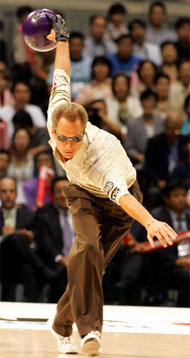 Back to bowling:
The goal of the bowler and the speaker is not to throw the ball straight down the middle towards the head pin, but instead to hit the space between the head pin and the pin right next to it.
This is called "hitting the pocket."
One way to do this is to bowl "straight." This requires precise aim every time.
Many bowlers say that the only way to score high consistently is by throwing a hook.
A hook is a ball that rolls in a curving pattern, thus hitting the pins with more force and requiring less precision.
Most of the time, bowlers first learn how to master the straight throw before they learn the hook.
As a beginning speaker, it can be tempting to experiment by throwing the audience a curve ball - taking them in a direction they don't expect at the start.
While I am all for creativity and risk taking, I follow the wisdom of the bowler.
Before you try to master the curve approach, first get your "straight throw" presentation down cold. No fancy footwork or great surprises. Just meaningful content and a powerful delivery.
Once you have that down, you can begin to learn how to throw a hook.
Sunday, January 10, 2010
Bowlers' Guide to Public Speaking
 Last night, I went bowling with some friends.
During the third frame, I threw the bowl straight down the middle - like an arrow pointed towards the center of the dart board.
To my dismay, I only knocked down seven pins. To make matters worse, the three pins left were on opposite sides of the alley. What's a bowler to do?
Turns out, the middle pin or head pin is not the one you want to hit if you hope to knock 'em all down.
A few frames later, I hit the pocket, that space right between the head pin and either pin next to it. Strike!
Often when we get up to speak, we try to hit that middle pin. We make our point so clearly and so directly, that we leave no space for the audience to absorb it. When you deliver the "straight down the middle" speech, many people may your understand message, but you will never truly wow the audience - you will never bowl a strike.
A really great speaker has the ability to deliver a message with force and precision - while deliberately leaving space for the audience to have that moment of self-discovery and transformation.
From the Green Room: When you get up to speak, aim for the pocket. Aim not just to get your point across, but to communicate in such a way to enables your listeners to discover your message for themselves.
Wednesday, January 6, 2010
More Speaking Wisdom from the Karate Kid
 Someone who read my last post on the Karate Kid asked me, "How can I ever hope to prepare like Danny LaRusso? I don't have time to practice repetitive motions all day!"
Oh yes, you do.
The average person speaks 16,000 words per day. That's 16,000 chances to practice your speaking skills.
The next time you are talking with a friend, practice maintaining sustained eye contact. The next time you read a story to your child, practice varying your voice. And the next time you speak to a sales clerk at the grocery store, practice keeping your body in an open stance.
Mr. Miyagi would be proud.
From the Green Room: Each day provides us with dozens of opportunities to practice using our voices. The more you work at strengthening your voice in casual conversation, the better you will sound when you get up to give a speech.
Friday, January 1, 2010
Wax On, Wax Off Public Speaking
 Yesterday, our family spent a delightful morning (re)watching the Karate Kid.
 One of my favorite scenes in the movie was when Mr. Miyagi teaches Daniel LaRusso karate by having him do a series of seemingly endless chores. For each chore, he instructs to Daniel to use a specific arm motion over and over again.
Frustrated, Daniel wonders when he will ever learn "real Karate?"
Just as he is about to throw in the towel, Mr. Miyagi demonstrates that the very motions he used to sand the floor, wax the cars, and paint the fence were exactly the motions Daniel needed to effectively block any punch. Those hours and hours he had spent practicing and mastering those simple motions paid off in spades.
One of the lessons we can learn here is about the importance of preparation.
People often ask me, "How can I learn to speak on the spot?" There are no magic tricks to mastering this skill.
If you know your stuff, keep up on your reading, and walk into meetings assuming that you could be asked to speak, you will do just fine.
From the Green Room: Being prepared means knowing your area of expertise well enough so that you are able to speak comfortably about it at any time. Each time you enter a situation where you could be asked to say something, assume you will be and prepare accordingly. Keep doing it. Over time, this will get easier and easier.
Can't wait to see the remake this year...
Subscribe to:
Posts (Atom)


 Posts
Posts

