Wednesday, March 24, 2010

Props, Not PowerPoint

Passover begins Monday evening. Our family will gather together for the Passover Seder - the retelling and re-experiencing of the Jewish people's exodus from slavery in Egypt.

Certainly, there's a lot of important information to cover. So, why not make a Passover PowerPoint presentation and show it at the Seder? Surely this would be a lot more "sophisticated" and "impressive" than the traditional, "old school" visual of the Seder plate!

So, what makes this such an awful idea?

Aside from certain religious prohibitions, one can only imagine that a PowerPoint presentation would turn a potentially meaningful, exciting and interactive experience into a dreadfully boring and passive one.

The Seder plate, on the other hand, with it's various, colorful symbolic foods, is a brilliant visual. It is concrete, tactile, and a great trigger for discussion of the topic at hand. What's more, it helps the participants remember the information, even after the holiday is over.

From the Green Room: Next time you give a presentation, consider minimizing your usage of PowerPoint, which inhibits human interaction and connection. Instead, choose a prop to emphasize your point. When used correctly, a prop not only helps you communicate your message, but helps your audience remember it, long after you have stopped speaking.

Saturday, March 20, 2010

Cover the Extremities

My three-year old daughter refused to wear a jacket for most of this winter. She did insist, however, on always wearing her hat and mittens.

As frustrating as this was as a parent, she was perfectly comfortable - as long as her extremities were covered.

The same holds true for eye contact during a presentation. Focus the majority of time on "the extremities" - the people at the edges of the room, who are the most likely to be ignored. When you look people on the edges, you include everyone and make everyone feel comfortable. When you focus mainly on the middle, you exclude the folks on the side - AND make those in the middle feel uncomfortable.

From the Green Room: Cover the extremities. The most important people to look at are the people at the farthest ends of the room. By focusing on the edges, you include everyone.

Wednesday, March 17, 2010

Awaken Possibilty in Other People

Listen to this remarkable speech by Benjamin Zander, the conductor of the Boston Philharmonic. Not only is Mr. Zander a conductor, but also a motivational speaker for business leaders:


About nine minutes into the talk, Mr. Zander describes a transformational moment in his conducting career, when he realized, "I don't make a sound....I realized that my job was to awaken possibility in other people."

What a wonderful metaphor for speaking!

So often when we get up to speak, we focus on the sounds we make, the words we say. This self-focus is what makes us anxious. After all, all eyes are on us, listening for what we have to communicate.

But imagine if we took the focus away from ourselves and saw our role as a conductor - to awaken the possibility in the people we are addressing.

This removal of focus on self might free us up to truly communicate and connect with the audience.

Monday, March 8, 2010

How to Give an Acceptance Speech

The acceptance speeches at last night's Academy Awards were unmemorable at best and dreadful at worst.

Only one speaker managed to give us a moment of grace - Sandra Bullock.


Without resorting to sappy cliches and narcissistic self-righteousness, she cut right the heart of the matter. Bullock was able to sum up in one sentence the essential message of the film - and then personalize that message in a way that felt completely authentic.

By choosing to take a moment and thank her mother, Bullock made us all feel appreciated and at the same time, paid a beautiful tribute to the film.

From the Green Room: Keep it simple. Keep it personal. Keep it short.

Friday, February 26, 2010

Remember Your Chest Voice

Does your voice jump an octave when your nervous?

You're not alone.

In this week's Slate magazine, Katherine Meizel analyzes why this week's American Idol singers were unable to hit their low notes:

It's not that they don't have the range, though; it's about the first-performance jitters. If you're anxious, the increased energy that higher pitches require—though they're more intimidating psychologically—can sometimes allow you to power your way through the nerves, but the more relaxed lower range you find at the beginnings of pop ballads becomes a stage fright minefield. Think about holding a rubber band when your hands are shaking: When you pull it taut, the intensified contraction of your muscles makes the quaver less noticeable; when the rubber band is slack, it trembles violently with your hands.

Maizel points to several of the performances including Ashley Lewis' cover of Leona Lewis' Happy:

http://www.youtube.com/watch?v=pfhfm6Zp_ZI

Women in particular, tend to react to nerves by speaking higher than normal and using their head voice. This can make us sound less authoritative.

One way to combat this is to practice speaking in your chest voice in everyday conversation.

Then when it's time to get up to speak, your voice will more naturally modulate to the lower registers.

Likewise, men have an opposite tendency to stay in the lower range when speaking and can also practice varying pitch in casual conversations or even when reading books to children.


From the Green Room: Practice varying the pitch of your voice. The more you practice experiment with the different ranges of your voice, the less likely you are to jump an octave when you're nervous.

Friday, February 19, 2010

Lindsey Vonn and the Power of Emotion

The Olympics is a great reminder of the power of emotion. While it is the athletics that impresses us, it is the stories and emotions that move us - and that ultimately stay with us.

Watch (or rewatch) Lindsey Vonn's reaction to her first gold medal on Wednesday.

http://www.nbcolympics.com/video/assetid=04fb8dfd-11ac-413d88ad-efb130f93ebd.html?chrcontext=goldenmoments#


Ultimately it is her outpouring of feeling that makes this moment so memorable.

This seems obvious in the context of the Olympics, but is a good reminder for any time you are trying to connect with an audience. Find the emotion. You can have the most powerful content in the world - but if you fail to tap into people's feelings, your message will not stick.

From the Green Room: People will remember most how they felt when they listen to you. Take time to identify the emotions you want to express to your audience. After all, emotions are contagious. If you feel inspired when you speak, so will your audience.

Tuesday, February 16, 2010

Find Your Green Room Trigger

How do Olympic athletes train their minds for the challenges of such intense competition? Turns out, they work with a "mental coach."

In a 2/10 article on NPR.org, "Mind Games: Making Olympians Mentally Fit," Howard Berkes writes about short track speedskater Katherine Reutter's struggle to overcome insecurity and anxiety.

She turned to Nicole Detting Miller, University of Utah sports psychologist:

...Miller helped Reutter relieve the pressure of Olympic competition by focusing on something that already defines her success. For Reutter, that event actually occurred off the ice, on a mountain slope outside Vancouver, where Reutter and her teammates struggled with an endurance exercise.

"It's so steep, it's so hard, that you can't run it," Reutter says. "You have to, like, lunge up it."

The men on the team had to climb the steep slope twice. Reutter was the only woman to join them on a second attempt. She started five minutes behind the men but beat two of them to the finish.

"I will be proud of that moment for my whole life," Reutter says. "And I never would have known what a huge accomplishment it was if Nicole hadn't forced me to realize it."

That strong sense of success applies to Reutter's upcoming Olympic experience.

"I know that even if I didn't win, I put in enough work that I could've won," Reutter says. "I will always be proud that even when it looks like I can't, even when I feel like I can't, I'm always willing to push a little harder just to see if maybe I can."

At Green Room Speakers, I call this finding your Green Room Trigger.

I can teach you how to identify a past success - a zone moment - and use it as a trigger each time before getting up to speak.

Over time, you will begin to asssociate speaking with that feeling of success and self-actualization.

From the Green Room: Speaking anxiety often stems from negative triggers, such as thinking about a past speaking or performance experience that didn't go so well. The Green Room Trigger helps you break that negative thought pattern and focuses you, instead, on your best self.

Monday, February 8, 2010

Drew Brees: Clarity of Purpose

Watch Saints' quarterback Drew Brees' MVP conference interview on NFL.com:

http://www.nfl.com/videos/nfl-super-bowl/09000d5d8164b81b/Drew-Brees-MVP-conference-part-1

During his opening statement, Brees says:

Our victory last night was the culmination of four years of hard work, fighting through a lot of adversity, ups and downs, and more importantly than that, representing a city that has been through so much – been through so many struggles and hardships.


Along the way, people have asked me so many times, ‘Do you look at it as a burden or extra pressure? You feel like you’re carrying the weight of the city on your team’s shoulders?’ I said, ‘No, not at all.’ We all look at it as responsibility. Our city, our fans give us strength. We owe this to them. That’s made all the difference.

Brees' eloquence and poise in this interview flow from his crystal clear sense of purpose and mission that he has had all along.

Speaking about his experience - and truly being able to capture the moment - then become effortless, as he knows exactly what his message is.

From the Green Room: Take time before you speak to clarify - in one sentence - what your purpose is. When you are able to fully own that purpose, everything flows from there.

Sunday, February 7, 2010

Candidate Sam Arora: Getting Right to the Point

Watch this video of Sam Arora, who is running for Maryland House of Delegates (Montgomery County, District 19):


Arora starts off by saying, "Hi, I'm Sam Arora, and I'm at the intersection of Georgia Ave and Layhill Rd, just a couple miles from where I live in Silver Spring."

Often speakers waste time at the beginning establishing their credibility. By the time they get to their message, the audience has lost interest.

Arora gets right to the point. By physically placing himself at a busy intersection then identifying his street names as just a couple of blocks from his home, Arora wastes no time and instead accomplishes three things at once:

1. He demonstrates his credibility as a local.

2. He shows a willingness to get out on the streets.

3. He shows a visual example of the particular problem he is trying to solve.

Unfortunately, the traffic behind him is not actually all that heavy, but he nevertheless gets his point across!

From the Green Room: Don't waste time at the beginning of your speech with too much personal background information. State only what your audience needs to know in order to be able to make your message compelling and believable. Get right to the point.

Today marks the One-Year Anniversary of this blog. It has been a terrific year. Thank you to my readers!

Can You Dig It: Meeting Your Audience Where They Are

Watch this video by two candidates from Maryland's 6th district: Jordan Hadfield (State Senate) and Todd Crandell (House of Delegates):


Despite the poor quality of the video, the message is brilliant.

By offering to get out there and shovel citizens' walkways, Hadfield and Crandell demonstrate a willingness to roll up their sleeves and get to work.

What's more, they communicate a precise understanding of the fundmental physiological needs of the community at the present moment.

Shovels in hand, they turn the inconvenience and isolation of a blizzard into a powerful opportunity connect with voters.

From the Green Room: Before you speak to any audience, try to figure out what they need most at this very moment. Once you identify that need, figure out a way to address it.

Tuesday, February 2, 2010

Steve Jobs and the Art of Leaving Things Out

Back in September, I wrote about Steve Jobs' ability to capture an audience through his passion.

Now I want to focus on his ability to capture an audience through his restraint.

In this Sunday's NYT Week in Review, Steve Lohr writes about Jobs' signature simplicity in Apple's products. Lohr writes that the products "cut through complexity by consciously leaving things out- not cramming every feature that came into an engineer's head, an affliction known as "featuritis" that burdens so many technology products."


"'A defining quality of Apple has been design restraint,' says Paul Saffo, a technology forecaster and and consultant in Silicon Valley."

Design restraint is at the core of Apple's success and should be at the core of your speech-writing process.

From the Green Room: When you craft a presentation, avoid "featuritis." Make conscious decisions to leave any information out that is not absolutely essential to your message.

Tuesday, January 26, 2010

Conan O'Brien and The Power of Unexpected Emotion


What made Conan O'Brien's farewell speech last Friday night so memorable?

Watch it here:

http://www.youtube.com/watch?v=JhKTUPBvqSc


The content was clearly very moving. And his delivery was both clear and powerful.

But what really made us sit up and listen was the shock of seeing someone who always cracks jokes suddenly and unexpectedly speaks with full sincerity.

From the Green Room: The next time you speak, take a moment to drop your usual persona and try something radically different. If you're normally loud - get quiet. If you are very serious - act goofy. And if you are always the comedian, take a moment to speak personally and sincerely to your listeners.

Your audience will remember that moment not only because it's so unexpected, but because you had the courage to reveal another side of yourself.

Thursday, January 21, 2010

Meet Your Audience Where They Are

The Folsom Prison scene from Walk the Line is so fantastic, I had to use it again.

The prison warden cautions Johnny Cash (Joaquin Pheonix) not to sing a song that reminds the prisoners they are in prison. Cash looks up and says, "You think they forgot?" He then walks out on stage, thanks the men for being "the best audience we've ever had" and sings Cocaine Blues:

When I was arrested I was dressed in black They put me on a train and they took me back Had no friend for to go my bail they slapped my dried up carcass in that country jail

How do the men react? They love it.

The scene has a decidedly redemptive quality to it. Out of respect for their current state, Cash chooses to sing a song about a criminal going to jail. And this is actually what enables the audience to transcend their current state and sing and cheer joyfully along with him.


From the Green Room: Whether you have bad news to give or you're speaking to an audience who's going through a rough time, don't hide from it. Go there with your audience. This kind of sincere honesty is both respectful and redemptive.

Saturday, January 16, 2010

Joaquin Phoenix Shows Us How to Use Prop

Using a prop, if it's done well, can be a powerful tool to make your message stick.

For a great example of this, watch the Folsom prison scene from the movie, Walk the Line:


From the Green Room: Try using a prop - and one prop only - to visualize and concretize your message. If you do it right, it could be the most memorable and powerful moment of your presentation.

Wednesday, January 13, 2010

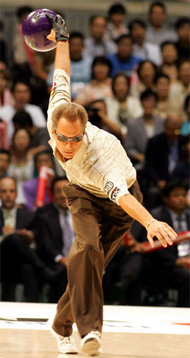
Bowlers' Guide to Public Speaking Part II: The Hook

Back to bowling:

The goal of the bowler and the speaker is not to throw the ball straight down the middle towards the head pin, but instead to hit the space between the head pin and the pin right next to it.

This is called "hitting the pocket."

One way to do this is to bowl "straight." This requires precise aim every time.

Many bowlers say that the only way to score high consistently is by throwing a hook.

A hook is a ball that rolls in a curving pattern, thus hitting the pins with more force and requiring less precision.

Most of the time, bowlers first learn how to master the straight throw before they learn the hook.

As a beginning speaker, it can be tempting to experiment by throwing the audience a curve ball - taking them in a direction they don't expect at the start.

While I am all for creativity and risk taking, I follow the wisdom of the bowler.

Before you try to master the curve approach, first get your "straight throw" presentation down cold. No fancy footwork or great surprises. Just meaningful content and a powerful delivery.

Once you have that down, you can begin to learn how to throw a hook.